Inline: Out of Time - Object Density Acoustic Model
Goal
Simulate echo/reverb from the proximity of several objects to the listener.
Notes
- This system applies to all sound effects in the game world, but parameters are only driven by object density around the listener. Modeling each source’s acoustic response, as perceived by a separate listener, based on the source’s unique surroundings would be far more complex and computationally expensive.
- This system foregoes stereo panning of reverberations. This would require independent echo/reverb DSPs for each channel with parameters driven by objects on each side of the listener.
Algorithm
Driving Data:
- Density of objects around the listener, determined by:
- The number of objects near the listener
- The average distance of nearby objects from the listener
Logic:
Initialization:
- The listener stores the positions of all static objects.
- Optionally, this may also record object sizes.
Each frame:
- Each dynamic collider reports its position to the listener.
- Colliders may optionally report their sizes.
- The listener sorts through the position data and ignores objects over a certain distance from the listener.
- The listener sets its echo/reverb DSP parameters as following:
- Echo/reverb balance:
- Number of objects near the listener
- More objects = biased toward reverb
- Less objects = biased toward echo
- Average distance of objects from listener
- Greater distance = biased toward reverb
- Lesser distance = biased toward echo
- Optional: average objects size
- More small objects = biased toward reverb
- More large objects = biased toward echo
- Number of objects near the listener
- Echo time:
- Average distance of objects from listener
- Greater distance = longer time
- Lesser distance = shorter time
- Average distance of objects from listener
- Reverb time:
- Number of objects near listener
- More objects = shorter time
- Less objects = longer time
- Number of objects near listener
- Effect level:
- Number of objects near listener
- More objects = lower level
- Less objects = higher level
- Number of objects near listener
- Echo/reverb balance:
Test Level Data

The test level consisted of 3 sloped corridors, each gradually increasing in room size. The first ramp contained no objects, the second contained a single row of objects, and the third contained two rows of objects. During data collection, the listener moved at a constant horizontal speed through the level.
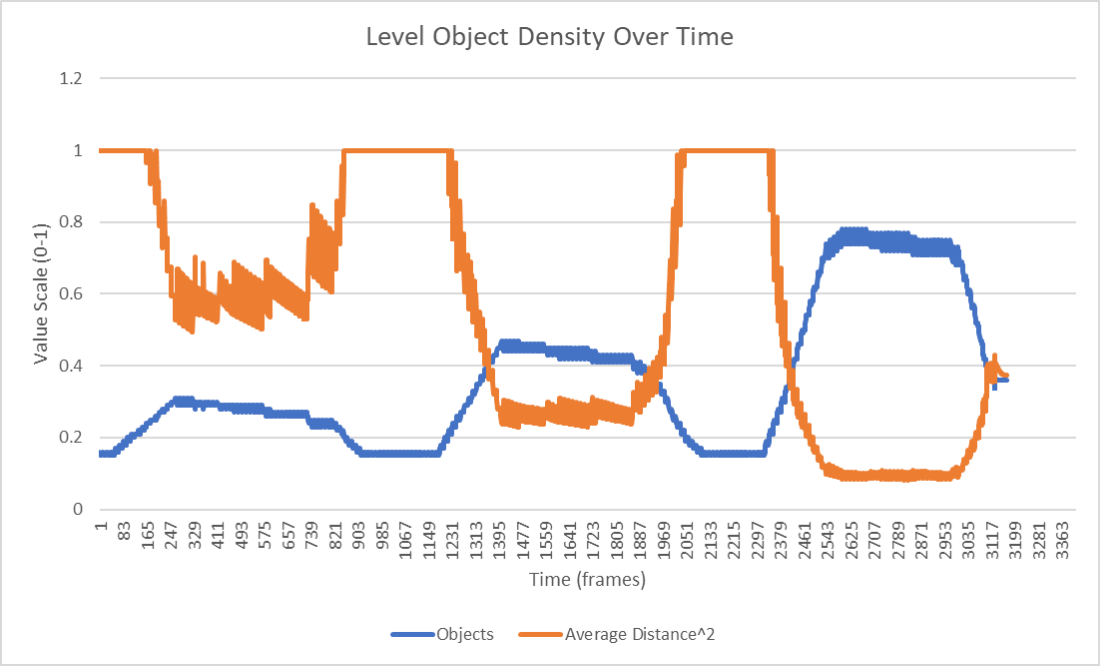 This graph illustrates the two parameters for the acoustic model, proximal object count and average object distance^2, as the listener moved through the test level at a constant rate. Frames below 250 may be disregarded, as they were affected by a mistakenly-placed foreground object.
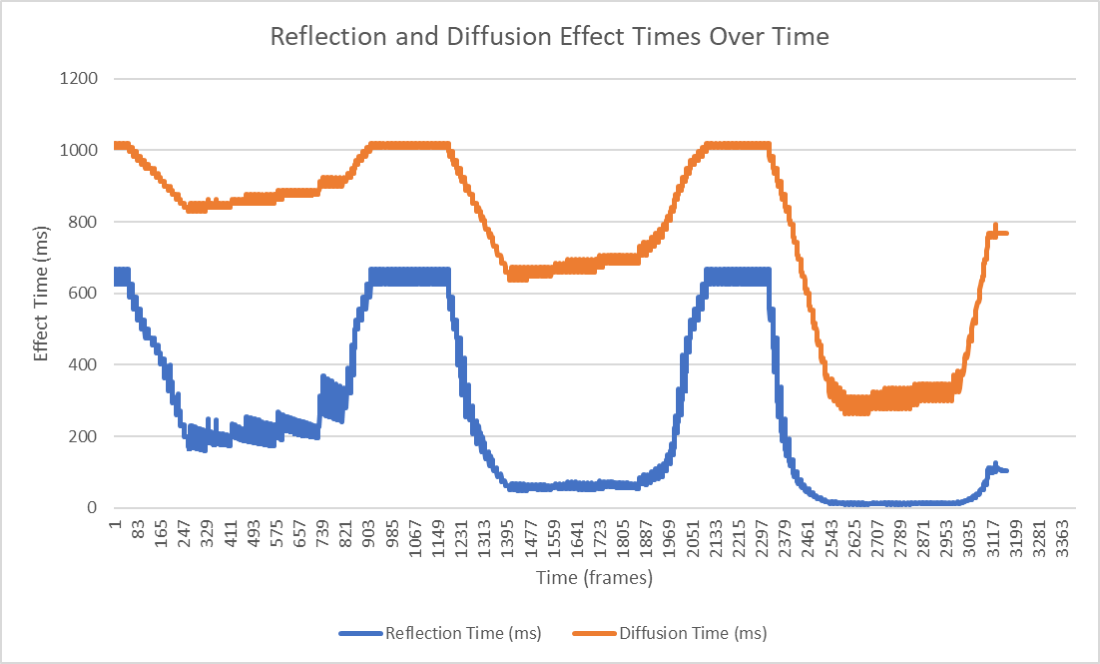 This graph illustrates the reflection and diffusion times in response to the object density parameters as the listener moved through the test level at a constant rate.
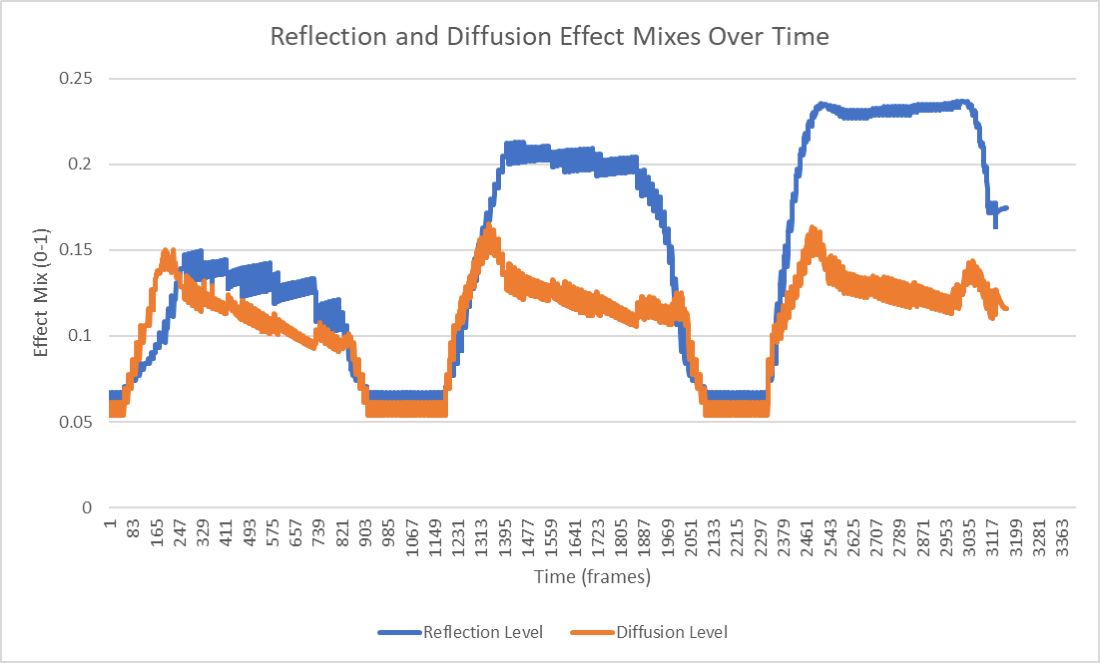 This graph illustrates the reflection and diffusion mixes, ranging 0-1, in response to the object density parameters as the listener moved through the test level at a constant rate.
Example Scenarios
Open Space
- Reflection:
- Amount: Very low
- Time: Short
- Diffusion:
- Amount: Very low
- Time: Long
Large Enclosed Space
- Reflection:
- Amount: Medium
- Time: Long
- Diffusion:
- Amount: Small
- Time: Long
Large Enclosed Space With Objects
- Reflection:
- Amount: Medium
- Time: Long
- Diffusion:
- Amount: Medium
- Time: Medium
Medium Enclosed Space
- Reflection:
- Amount: Medium
- Time: Medium
- Diffusion:
- Amount: Medium
- Time: Medium
Medium Enclosed Space With Objects
- Reflection:
- Amount: Low
- Time: Medium
- Diffusion:
- Amount: Medium
- Time: Short
Small Enclosed Space
- Reflection:
- Amount: High
- Time: Short
- Diffusion:
- Amount: Small
- Time: Medium
Small Enclosed Space With Objects
- Reflection:
- Amount: Very low
- Time: Very Short
- Diffusion:
- Amount: Very low
- Time: Very short
Possible Optimizations
- A simplified data model could assume reverberation time and level solely from the number of objects near the listener.
- Updates could be distributed over multiple frames.
Related Posts
Inline: Out of Time - Adaptive Soundtrack System Overview
Architecture breakdown of Inline: Out of Time's gameplay-driven adaptive soundtrack system.
Inline: Out of Time - Audio Engine Overview
An overview of the powerful audio engine behind Inline: Out of Time's rich soundscape and audio-driven visuals.
Inline: Out of Time - Positional Sound
Breaking down the formulae driving Inline: Out of Time's stereo imaging.
Kouncil: Algorithm Reference
Every analysis algorithm in Kouncil, the mastering analyzer: loudness, dynamics, spectral, perceptual, stereo, codec simulation and render QC.